Volkswagen’s Rally Is a Cost-Cutting Bet, Not an Autos Recovery Signal
Co-determination
Germany’s corporate governance system that gives worker representatives formal influence over major company decisions, including through supervisory boards.
Fixed-cost leverage
The earnings sensitivity created when a company has large costs that do not fall automatically with lower volumes, such as factories, labour agreements and overhead.
Excess capacity
Production capacity that exceeds expected demand, often pressuring margins because factories and staff remain costly even when fewer vehicles are sold.
Operating margin
Operating profit as a percentage of revenue; it is a key measure of how much profit a company generates from its core business before financing and tax effects.
Volkswagen Group
other
Investor and Analyst Call - Future Plan 2030
Reuters via MarketScreener
news
European shares log weekly losses on inflation worries; Volkswagen jumps
Reuters via MarketScreener
news
Fear and compromise: How Volkswagen struck a deal over historic job cuts
Shares Jump
Volkswagen rose 5.9% on September 4, helping lift the broader European autos index by 1.1%.
50,000 Cuts
Volkswagen’s plan includes an additional roughly 50,000 workforce reduction as part of its Future Plan 2030.
9% Target
The group is targeting a 9% operating margin by 2030, versus a reported 3.8% margin in the first half of 2026.
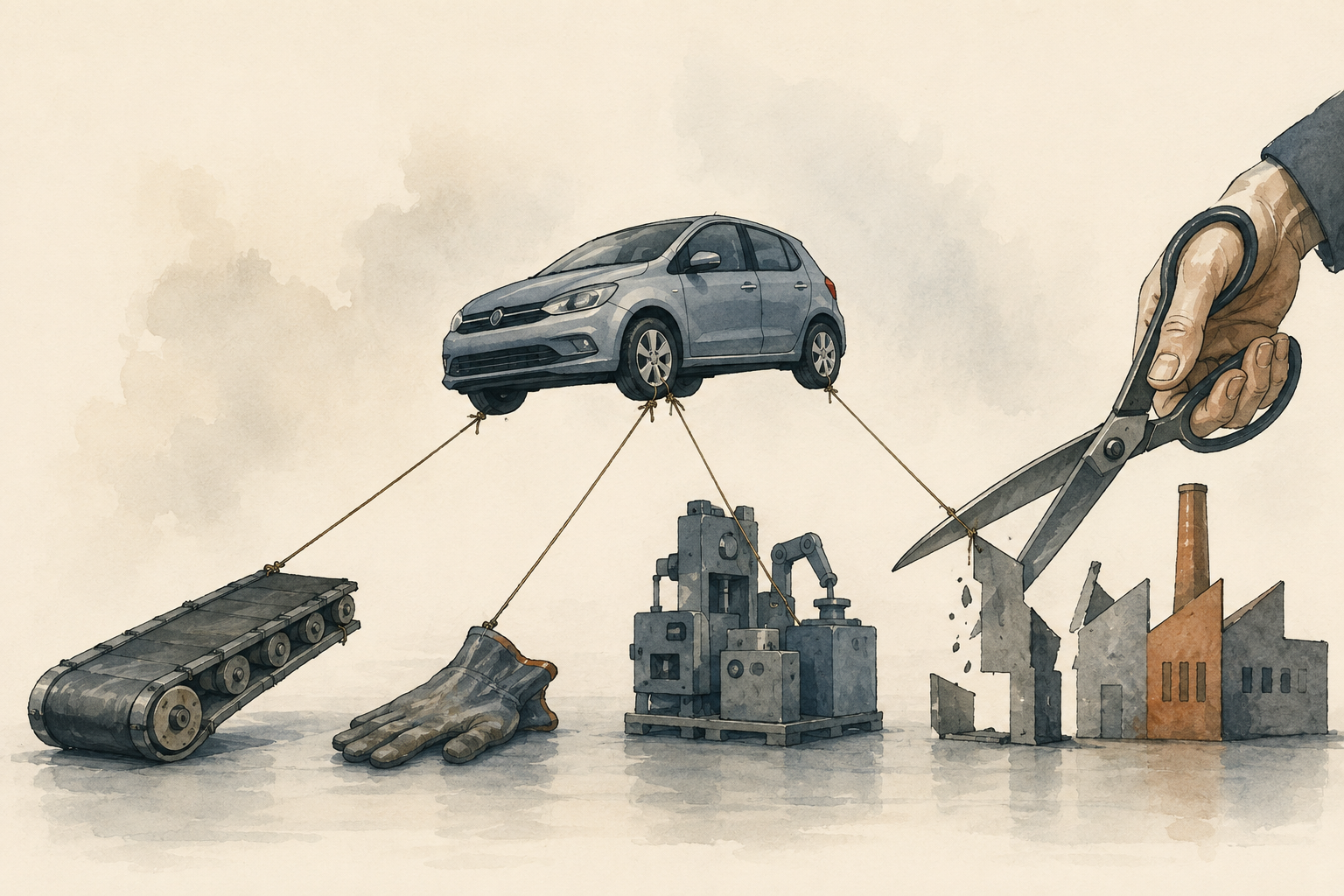
Volkswagen’s September 4 share-price rally was less a vote of confidence in an auto-cycle recovery than a repricing of restructuring credibility. The stock rose 5.9% to a two-month high after the supervisory board approved its sweeping Future Plan 2030, helping lift the broader European autos index 1.1% even as the STOXX 600 posted a weekly loss on inflation and rate concerns.2
For European equity investors, the message is clear: the autos trade remains defensive. In a sector still pressured by U.S. tariffs, weak European demand and Chinese competition, the market rewarded Volkswagen not for selling more cars, but for showing it may be able to cut labour, capacity and model complexity from a legacy cost base built for a larger, more profitable market.
The plan gives management a 2030 framework built around annual sales of 9 million vehicles, a 9% operating margin target and €135 billion of capex and R&D spending for 2027-2031.1 The stronger equity signal sits beneath those targets: more than 500,000 units of excess European capacity to be addressed, an additional workforce reduction of roughly 50,000, a 50% cut in model count and a 75% reduction in component variety by 2035.1
The rally stood out because Volkswagen’s operating backdrop remains weak. Reuters reported that the company continues to face pressure from U.S. import tariffs, a stagnant European market and aggressive Chinese rivals, all of which have hurt margins and weighed on the stock. Even after Friday’s gain, shares were still down 22% year to date.2
That makes the move less a classic cyclical re-rating than a governance event. The supervisory board’s approval eased a key investor concern: whether Volkswagen’s co-determined structure, unions and Lower Saxony’s influence could block economically necessary restructuring. Reuters’ reconstruction of the deal showed how management, labour and state stakeholders avoided a potentially damaging escalation, while also noting that the vote is not a final solution because the cuts still require union negotiations.4
The Guardian reported that Deutsche Bank analysts described the approval as a “fundamental breakthrough” and a “much-better-than feared outcome,” arguing that the market debate was about whether Volkswagen’s challenges could realistically be addressed inside its complex governance system.8 That framing matters for valuation. If investors believe management has a mandate to act, a low multiple can begin to reflect self-help potential rather than permanent impairment.
The scale of the plan explains why the equity market focused on costs. Volkswagen’s official investor materials identify more than 500,000 vehicles of excess European capacity and say four plants — Emden, Zwickau, Hanover and Neckarsulm — currently lack future model allocation for 2031-2034.1 The same plan targets an additional group-wide workforce adjustment of roughly 50,000 positions, including a quarter of global management roles.1
This is the core of the bull case: not that Volkswagen can suddenly outgrow BYD or reverse Europe’s demand malaise, but that it can lift earnings power by producing fewer models, with fewer variants, at higher volumes per model and with less overhead. The Irish Times, citing Bloomberg, reported that Citi saw the deal as enabling Volkswagen to move capital toward higher-return brands and models without having to maintain excess capacity utilisation.10
The share reaction may also matter beyond Volkswagen. If investors increasingly view European autos as a restructuring trade, companies with credible levers on labour, platforms, procurement and capital allocation may be favoured over those relying mainly on volume recovery. Manufacturers that cannot show cost flexibility risk being treated as structurally over-capacitated incumbents.
The external pressures remain substantial. AP reported that Volkswagen’s restructuring reflects the force of the China shock hitting Germany’s economy, noting that Chinese competitors have launched hundreds of new models into a market where Volkswagen’s sales have fallen and pricing has weakened.7 Chinese automakers including BYD, Geely and Chery are also gaining share in Europe, increasing pressure on incumbents that must fund electrification while defending margins.7
Tariffs add another earnings headwind. AP reported that Volkswagen faces a 15% tariff on cars from Europe and up to 27.5% on cars imported from its Mexican plants.7 Moneycontrol reported that Volkswagen’s first-half 2026 operating margin slipped to 3.8%, with operating profit down 11.6% and profit after tax down 31%, while the company attributed the decline to U.S. tariffs, weaker China business and other charges.13
Those figures make the 9% margin target look ambitious. They also explain why investors reacted to the cost plan despite the absence of a demand inflection. A manufacturer starting from a 3.8% margin does not need a perfect revenue environment for restructuring to matter. It needs credible evidence that fixed costs can fall faster than pricing and tariff pressure erode gross profit.
The board vote reduces uncertainty, but it does not remove it. Reuters reported that plant solutions remain unclear and that the approved cuts still require union negotiations, leaving open the risk of strikes and delays.4 The Irish Times also noted that workers secured assurances that no factory would be immediately abandoned and that contentious site decisions would be worked through in coming months.10
Investors should separate the announcement effect from the earnings effect. The announcement improves confidence that Volkswagen is not unfixable. The earnings effect depends on whether management can convert planning assumptions into lower labour expense, simpler production, disciplined capital allocation and fewer underused assets.
There is also a strategic trade-off. Cost cutting can defend margins, but it can reduce flexibility if demand improves or if the company cuts too deeply into engineering, software or EV capability. Reuters cited AJ Bell’s Dan Coatsworth warning that investors often applaud major cost-cutting exercises, but companies risk leaving themselves short of resources if demand recovers.2
Volkswagen’s rally suggests investors are not waiting for a broad European volume rebound to re-engage with the sector. They are looking for proof that legacy manufacturers can behave more like capital-disciplined industrials: fewer models, less complexity, lower fixed costs and more selective investment.
That could create a two-tier European autos market. Companies that show credible restructuring capacity may receive relief rallies even in a weak macro environment. Those with unresolved labour, plant or governance constraints may continue to trade at depressed multiples, especially while Chinese competition and U.S. tariffs limit confidence in revenue growth.
For Volkswagen, Future Plan 2030 is best viewed as a necessary but insufficient condition for re-rating. The nearly 6% share jump shows investors are willing to reward defensive self-help. Sustained outperformance will require evidence that the company can turn a political compromise into measurable margin expansion without sacrificing the product and technology investment needed to compete with faster-moving Chinese rivals.







Comments