Russia and China veto Iran sanctions panel, shifting enforcement beyond U.N.
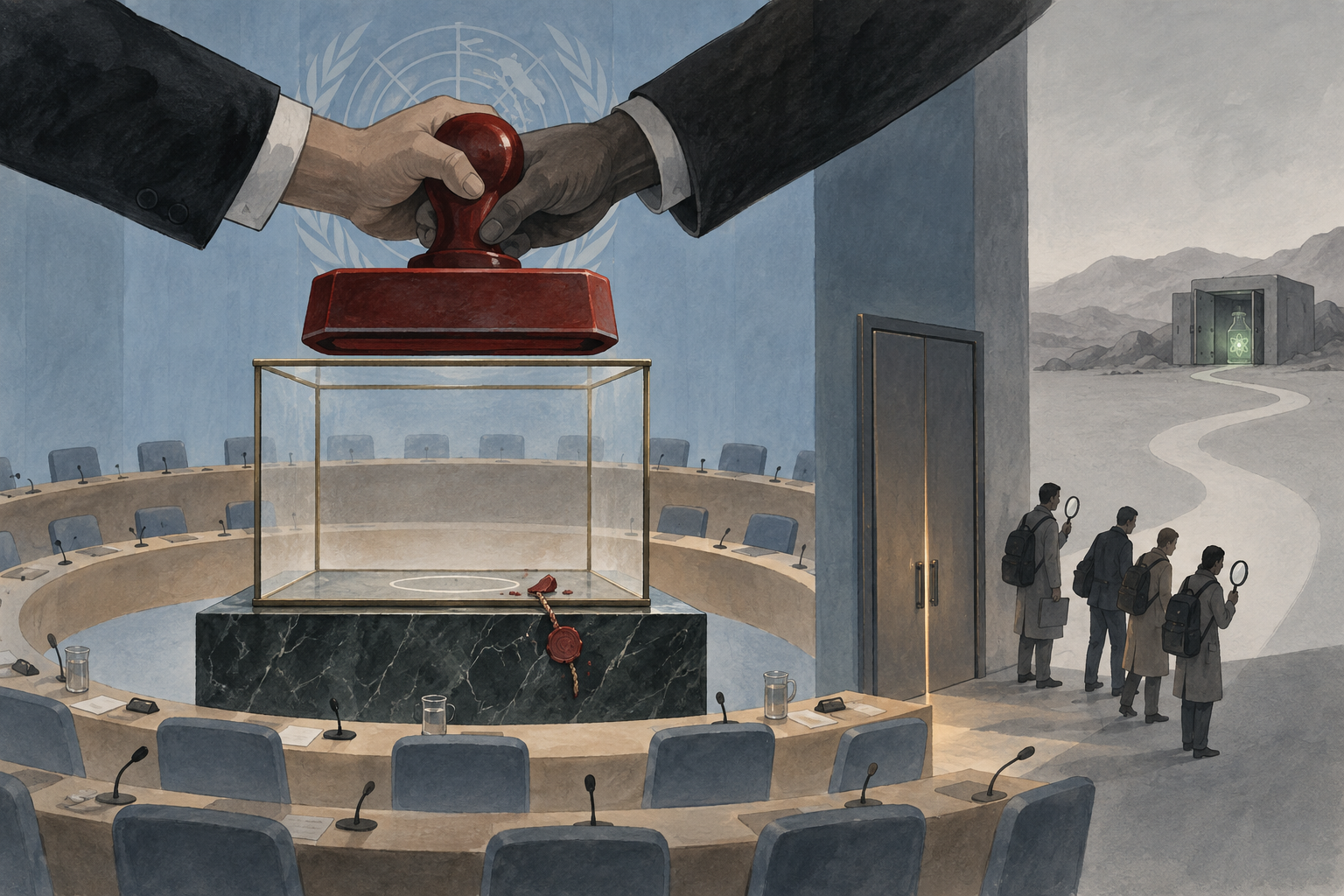
Panel of Experts
A U.N.-mandated group of specialists that monitors sanctions implementation, investigates suspected violations and reports findings to the Security Council.
Security Council veto
Any of the five permanent Council members — the United States, Russia, China, Britain and France — can block a substantive resolution by voting no.
Unilateral sanctions
Penalties imposed by one government or bloc, rather than by the U.N., often targeting financial access, trade, travel or specific companies and individuals.
Enriched uranium stockpile
Uranium processed to increase the share of the U-235 isotope; the amount and enrichment level are central indicators in nuclear monitoring.
United Nations Meetings Coverage and Press Releases
government
Security Council Fails to Renew Iran Sanctions Panel amid Dispute over ‘Snapback’
Associated Press
news
Russia and China halt US proposal on Iran sanctions at the UN
U.S. Department of the Treasury
government
Operation Economic Outcast Disrupts Digital Asset Exchange Enabling the Iranian Regime
Untracked bias
100% of tracked sources are High factuality
Bias and factuality ratings from Media Bias Fact Check. Outlets without a rating are marked “Untracked.”
Vetoed mandate
Russia and China blocked a U.S. proposal to renew the U.N. Panel of Experts monitoring Iran sanctions in an 11-2-2 Security Council vote.
Monitoring gap
The veto ends a standing U.N. investigative mechanism while inspectors remain unable to verify Iran’s enriched-uranium stockpile.
Unilateral shift
Washington signaled a parallel enforcement track with new Treasury sanctions targeting alleged Iranian sanctions-evasion networks.
Russia and China vetoed a U.S.-drafted Security Council resolution on Sept. 17 that would have extended the mandate of the U.N. Panel of Experts monitoring sanctions on Iran. The vote ended a key mechanism for investigating suspected violations and reporting them to the Council.1
The resolution failed 11-2, with two abstentions. U.N. sanctions on Iran remain formally in place, but the vote removes the independent expert body that helped member states identify evasion networks, assess implementation and document alleged breaches.14 The veto came as U.N. nuclear inspectors remain unable to verify Iran’s enriched-uranium stockpile after earlier strikes disrupted monitoring, according to Western officials cited in the debate.24
For Washington and European governments, the immediate loss is not the legal basis for sanctions but the Security Council’s enforcement capacity. Without the panel, the Council loses a standing investigative arm able to collect information from governments, inspect evidence, trace procurement routes and produce reports that can support diplomatic pressure or future designations.15
That gap is expected to push enforcement toward a looser model: intelligence sharing among Western governments, national sanctions actions, customs and export-control investigations, and possibly a Western-organized monitoring team outside the U.N. framework.2 The shift gives Iran more diplomatic breathing room in a stalemated war by exposing divisions among the Council’s permanent members and reducing the likelihood of unified U.N. follow-through on alleged violations.6
The Panel of Experts was not a sanctions committee with power to punish Iran on its own. Its role was to monitor implementation, investigate suspected breaches and provide the Council with technical reporting on how restrictions were being evaded or enforced.1
That role mattered because U.N. sanctions enforcement depends heavily on member-state reporting. Expert panels can turn scattered national findings into a shared evidentiary record, making it harder for governments to dismiss alleged violations as purely political claims. Britain said the veto weakens the Council’s understanding of how sanctions are being implemented, while stressing that the binding measures themselves do not disappear with the panel’s mandate.4
The Associated Press reported that existing U.N. measures still include restrictions tied to arms, missiles and nuclear-related activity. But the expert body charged with monitoring those measures will no longer operate unless the Council agrees on a new mandate.2
U.S. and European officials argued that the timing is especially damaging because the International Atomic Energy Agency has not been able to verify Iran’s enriched-uranium stockpile following earlier strikes.24 In practical terms, the end of the panel narrows the U.N.’s visibility into sanctions evasion and the networks that could support prohibited procurement.
The United States signaled immediately that it would keep pursuing Iran-related sanctions outside the U.N. system. On the same day as the vote, the Treasury Department announced what it called “Operation Economic Outcast,” targeting digital-asset and commercial networks it alleged helped the Iranian government evade sanctions.3
The Treasury action included designations of BitBank, Pishtaz Simorgh Electronic Trade Company and associates of Babak Zanjani, whom Washington accused of helping build sanctions-evasion infrastructure for Iran.3 The move illustrated the parallel track now likely to become more important: unilateral financial penalties, exchange and payment-network investigations, export-control enforcement, and coordinated actions among aligned governments rather than Council-wide action.
European governments are likely to face a similar choice. They can continue to argue that U.N. restrictions remain binding while relying more heavily on national intelligence, customs enforcement and joint statements to document violations. But without a U.N. panel, any Western-led monitoring team would carry less universal legitimacy and could be rejected by Russia, China and Iran as politically driven.27
That legitimacy gap matters for sanctions policy because enforcement is not only a legal process. It also depends on persuading banks, insurers, shippers, port authorities and third-country regulators that evidence of evasion is credible and politically durable. A U.N. expert report can give those actors a multilateral reference point. A national sanctions notice can move faster, but adversaries can more easily frame it as unilateral pressure.
Iran is likely to read the veto as evidence that Washington and its European partners cannot command Security Council unity at a critical moment. Iranian state-aligned media framed the U.S. draft as politically motivated and emphasized Russian and Chinese opposition to Western pressure.8 Al Jazeera reported that Iran publicly thanked Russia and China after the vote.5
That does not remove the economic risk Iran faces from U.S. and European penalties. U.S. sanctions can still restrict access to the dollar-based financial system, deter counterparties and expose alleged evasion networks. But the veto reduces the chance that new allegations will be processed through a unified U.N. mechanism with buy-in from all permanent Council members.
Russia and China argued against the U.S. approach during the Council clash, while Western governments accused them of shielding Tehran and weakening sanctions oversight.67 The result is a more fragmented enforcement environment in which Iran can point to great-power division even as Western governments continue to pursue penalties.
For Tehran, that fragmentation may be diplomatically useful. It can seek support from Moscow and Beijing in Council debates, challenge Western evidence as selective, and exploit uncertainty among third countries deciding whether to align with U.S. and European enforcement priorities or wait for U.N. consensus that may not come.
The veto does not end U.N. sanctions on Iran, and it does not prevent the United States or European governments from imposing their own measures.4 But it removes a central source of shared monitoring at a time when the nuclear file is already clouded by gaps in inspector access and uncertainty over Iran’s enriched uranium.24
The practical effect is a sanctions regime with less common evidence, more reliance on national enforcement and greater room for competing narratives. Washington and European capitals can still identify alleged violations and punish companies, banks, shippers or digital-asset platforms they accuse of helping Iran. What they have lost is the Security Council-backed expert process that could convert those findings into a broadly recognized U.N. record.
In a divided Council, that may be the veto’s most important consequence: not the disappearance of sanctions, but the erosion of the mechanism that made their enforcement more collective.







Comments