CAFTA 3.0 gives Beijing a practical platform for China-ASEAN diplomacy
September 18, 2026
China says the upgraded China-ASEAN free trade pact has been signed and is moving through legal procedures toward entry into force. The agreement gives Beijing a concrete economic framework for deepening regional ties in digital trade, green development, standards and connectivity as Southeast Asian governments manage wider Indo-Pacific alignments.

7m

World
5m
India pushes rules-based connectivity and secure supply chains at SCO trade meeting
At an SCO ministers’ meeting in Dushanbe, India framed economic cooperation around trusted connectivity, customs simplification, resilient supply chains and WTO-centred rules. The stance signals New Delhi’s effort to shape the China- and Russia-heavy forum as a venue for market access and supply-chain security after the Modi-Xi thaw.

World
6m
China uses Manchuria anniversary to press Japan on security debate
Beijing used the 95th anniversary of the September 18 Incident to accuse Japanese right-wing forces of historical denialism and warn against revived militarism. The statement shows how wartime memory is again functioning as a diplomatic tool as Tokyo prepares revisions to its security strategy.

World
6m
Russia and China veto Iran sanctions panel, shifting enforcement beyond U.N.
Russia and China blocked a U.S. proposal to extend the U.N. expert panel that monitors Iran sanctions, removing a formal Security Council enforcement tool while inspectors remain unable to verify Iran’s enriched-uranium stockpile. The move is likely to shift monitoring toward Western-led intelligence sharing, national sanctions and ad hoc investigations outside the Council.
Houthi Advance Opens New Yemen Front at Red Sea Chokepoint
September 18, 2026
The Houthi seizure of Mokha and nearby islands has turned a Red Sea shipping crisis back into a Yemeni ground war, threatening Saudi-linked energy routes and adding a second maritime pressure point for Iran alongside Hormuz. The advance redraws front lines around Mokha, Marib and Taiz while exposing limits in Saudi and U.S. deterrence.

7m

World
7m
Russian strikes near Poland sharpen NATO air-defense dilemma
Russia’s Sept. 17 missile-and-drone wave hit Kyiv and western Ukraine while Poland scrambled aircraft, sounded sirens in eastern areas and temporarily halted flights at Rzeszow and Lublin. Even without a confirmed Polish airspace violation, the attack pattern is making NATO-adjacent logistics hubs a more acute escalation-management problem.

World
7m
Canada ‘associate member’ offer tests EU partnership machinery
Ursula von der Leyen’s proposal to make Canada the EU’s first “associate member” has created a political opening but not yet a legal category. The next test is whether EU institutions and member states turn the label into a formal foreign-policy instrument or leave it as diplomatic shorthand for closer cooperation.

World
5m
Andersson faces coalition test after Sweden’s left-leaning bloc wins narrow majority
Sweden’s final election count gave the Social Democrats, Greens, Left Party and Centre Party a narrow 176-173 Riksdag majority, prompting Prime Minister Ulf Kristersson to resign. Speaker Andreas Norlén has opened consultations as Magdalena Andersson tries to turn an ideologically stretched anti-right bloc into a workable government.
Euro-Area Inflation Revision Leaves Energy Problem Intact
September 18, 2026
Eurostat’s final August reading trimmed euro-area inflation to 3.2% from the 3.3% flash estimate, but the investment signal is little changed: energy is again lifting headline prices. That keeps pressure on real incomes, corporate margins and long-duration equity valuations as European markets digest ECB tightening and a wider bond-market repricing.

5m

Finance
7m
Drax EBITDA upgrade shows UK grid flexibility is turning into earnings power
Drax now expects 2026 adjusted EBITDA around the top end of the £680mn–£711mn consensus range after summer system-support gains and the consolidation of Bluefield Solar Income Fund. The key investor question is whether heatwave-led balancing income is cyclical upside or evidence that dispatchable generation, batteries, solar optimisation and scarce grid access are being re-rated by the UK power market.

Finance
6m
Wizz Air’s Capacity Cut Matters More Than Its Stronger Summer RASK
Wizz Air’s 5% reduction to planned second-half capacity looks like sensible earnings protection while fuel prices stay elevated. But it also raises a harder question for investors: whether the airline’s 2030 growth and margin targets remain credible if oil holds above $100.

Finance
7m
Softcat’s $1.05bn GDT deal adds US AI-infrastructure scale — and execution risk
Softcat is making its largest strategic move into North America with the $1.05bn acquisition of GDT, pairing upgraded FY2026 profit guidance with a debt-and-equity-funded bet on data-centre, networking and AI infrastructure demand. The opportunity is credible, but UK mid-cap investors now need to underwrite leverage, dilution and integration risk at a mature point in the AI capex cycle.
BoE’s gilt-sale pause eases duration stress, not fiscal risk
September 18, 2026
The Bank of England has separated a hawkish inflation signal from a market-stabilising QT reset, giving long gilts and UK equities a near-term lift. The durability of the rally now depends less on the six-month sales pause than on whether the October budget restores confidence in the gilt supply outlook.

7m

Business
5m
LNG Canada Expansion Could Put Kitimat at Center of Asia’s Supply-Security Trade
A possible Phase 2 final investment decision at LNG Canada as early as October would be more than a capacity bet by Shell and its partners. It would test whether Asian buyers are willing to pay for secure, non-U.S. Pacific supply as Middle East shipping risks reshape LNG procurement.

Business
6m
Softcat’s $1.05 billion GDT deal pushes UK reseller deeper into U.S. infrastructure services
Softcat agreed to buy Dallas-based GDT for a $1.05 billion enterprise value, using equity, debt and cash to accelerate its move into U.S. data-center and networking services. The transaction gives Softcat a larger North American platform for AI-era infrastructure demand, but the investment case depends on integration, retention and delivering higher-touch services across borders.
Business
5m
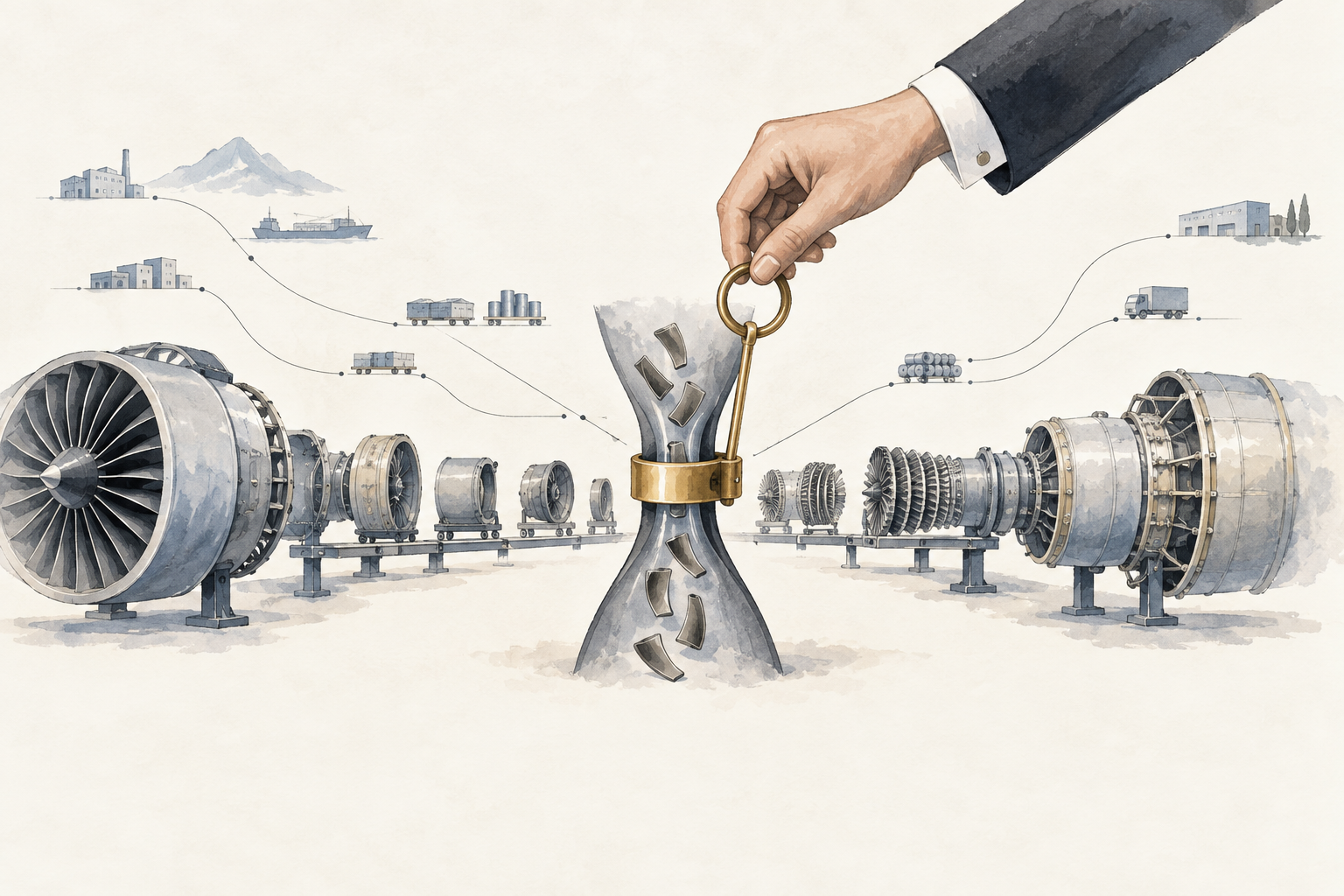
GE Aerospace’s CPP Deal Targets a Bottleneck, Not Full Vertical Integration
GE Aerospace’s planned $11.75 billion purchase of Consolidated Precision Products highlights a narrower industrial strategy: own a supplier where shortages can stop engine output, while continuing to rely on outside vendors across most of the value chain.